In this article, what has been accomplished?
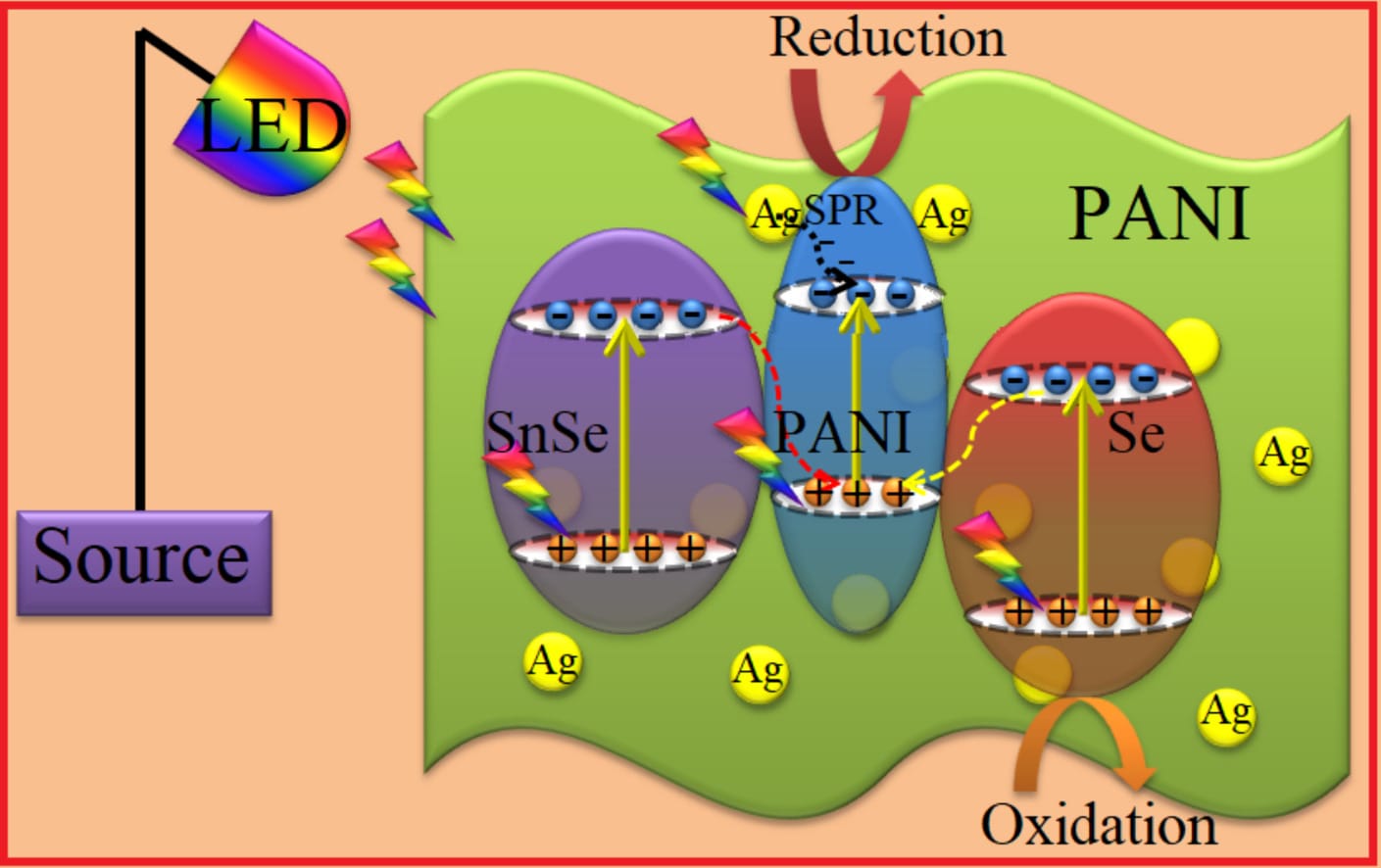
This study develops an S-scheme SnSe/Ag–polyaniline heterostructure designed to break down methylene blue dye and tetracycline antibiotics under visible light. By functionalizing polyaniline with silver nanoparticles, the researchers introduced surface plasmon resonance (SPR) effects that boost electron activation and suppress electron–hole recombination. As a result, the SnSe/Ag–PANI photocatalyst achieves over 95% dye degradation within 50 minutes and 99% antibiotic removal in 105 minutes, while maintaining stability over repeated cycles. The work shows how combining a metal selenide, a conductive polymer, and plasmonic silver can create a powerful and reusable photocatalyst for wastewater purification.
With this paper, how can we close the gaps?
Author's words...
The project was conducted by research teams at Islamic Azad University (Masjed-Soleiman and Islamshahr branches) under the scientific leadership of Prof. Ramin Yousefi. Notably, a portion of the development and collaborative research support came through BMF Science Group, whose mission focuses on advancing scalable, green nanotechnology for real environmental impact. This work directly reflects BMF’s vision of transforming laboratory nanomaterials into practical, industry-ready solutions that address pollution and public health challenges at international scale.