
Table of Contents
Introduction
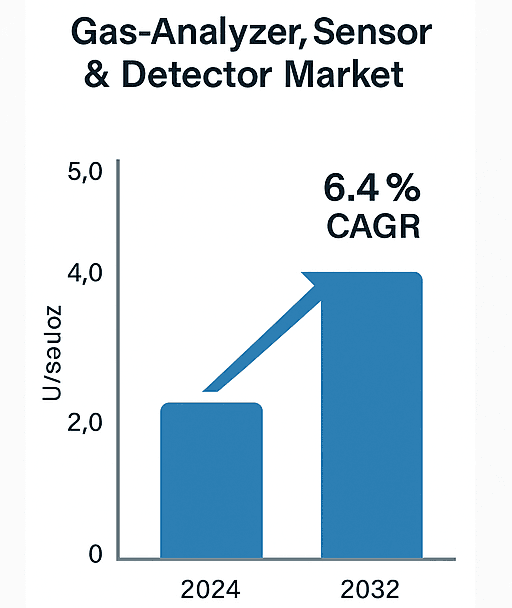
The global market for gas analyzers, sensors, and detectors is forecast to expand from US $4.3 billion in 2024 to US $7.2 billion by 2032, reflecting a compound annual growth rate (CAGR) of 6.4 %.
This steady rise underscores how safety regulations, environmental policies, and the integration of IoT and AI technologies are reshaping industrial sensing. For organizations like BMF-Science, which bridge research and industry, this growth highlights expanding opportunities for R&D collaboration and technology transfer in smart sensing solutions.
Background & Context
Gas analyzers, sensors, and detectors are crucial instruments for monitoring gas concentrations in workplaces, manufacturing plants, and the environment.
They enable real-time detection of leaks and emissions, prevent hazardous exposure, and ensure regulatory compliance.
According to a 2025 market analysis by DataM Intelligence, global demand is driven by increasing safety mandates and the shift toward smart, connected industries. Major players include General Electric, ABB, Emerson Electric Co., and Siemens, indicating both strong industrial investment and the vital role of research-driven innovation.
Technological & Scientific Insights
Key Growth Drivers
- Regulatory enforcement: Governments are mandating continuous emission monitoring and workplace safety compliance, increasing the need for precision gas analyzers and detectors.
- IoT + AI Integration: The next generation of devices features real-time connectivity, predictive analytics, and automated maintenance alerts.
- Expanding Applications: Beyond oil & gas and manufacturing, sensor systems are being adopted in healthcare, building automation, and water treatment — sectors increasingly reliant on accurate gas detection.
Sensor Technologies & Research Opportunities
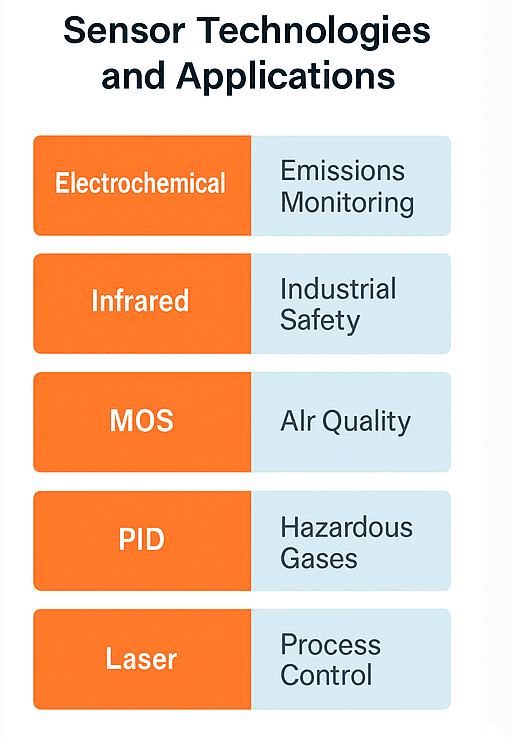
The report identifies diverse sensing technologies — electrochemical, infrared (IR), metal oxide semiconductor (MOS), catalytic, zirconia, photo-ionisation detection (PID), and laser-based methods.
Each technology presents opportunities for innovation in materials science, microelectronics, and data analytics.
Academic research into miniaturised MEMS sensors, AI-based signal processing, and low-power IoT architectures directly feeds into commercial development pathways.
Industry Impact & R&D Implications
Industry Impact & R&D Implications
The industrial adoption of advanced gas-sensing systems will influence:
- Process automation — embedding smart sensors in production lines and digital twins.
- Predictive maintenance — using real-time analytics to prevent failures.
- Environmental reporting — ensuring accurate emission tracking for ESG compliance.
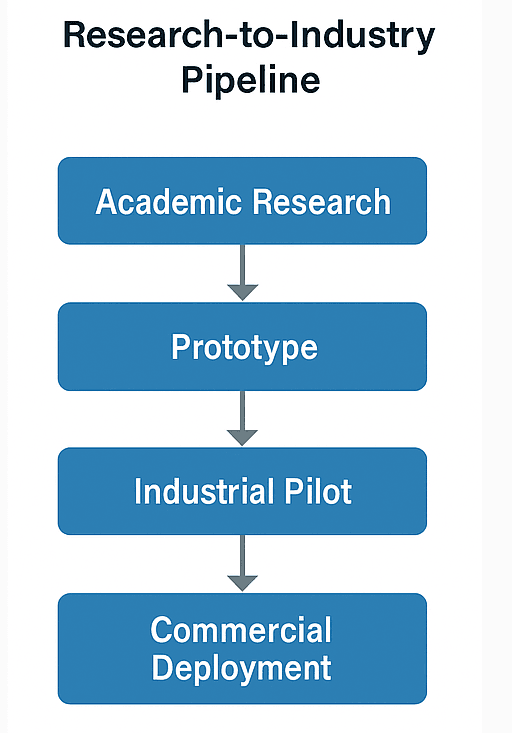
For universities and research centres, this growth represents a clear avenue to translate lab-scale innovations into industrial solutions. Collaborative efforts between academia and manufacturers can accelerate commercial deployment, improve safety, and reduce environmental risks.
At BMF-Science, such synergy is the foundation of our mission: helping scientists and companies collaborate to bring cutting-edge sensing research into industrial reality.
Funding, Collaboration & Strategic Opportunities
The market’s upward trend aligns with international funding priorities in:
- Environmental monitoring and decarbonisation.
- Industrial safety and occupational health technologies.
- Digital manufacturing and Industry 4.0 transformation.
Joint initiatives among universities, industrial R&D departments, and policy agencies are key to sustaining innovation. Start-ups developing breakthrough sensor designs or algorithms can partner with major industry players to scale production and global distribution — a process where structured mediation, such as that facilitated by BMF-Science, becomes essential.
BMF-Science Perspective
At BMF-Science, we believe the future of gas-sensing technology exemplifies how scientific discovery can drive industrial sustainability.
We connect research teams exploring next-generation sensors with manufacturers and investors seeking tangible innovation in industrial monitoring and safety.
Through our global scientific network and collaboration programs, we accelerate the translation of research into real-world technologies — ensuring that innovation doesn’t stay in the lab but reaches the industries that need it most.
Contact our experts to explore collaboration opportunities, access funding programs, or scale your gas-sensing innovations to industry.