Table of Contents
Introduction
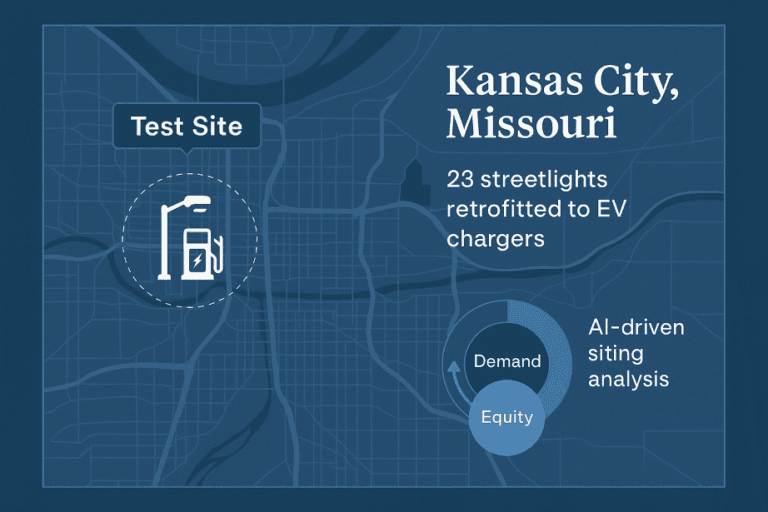
As cities worldwide accelerate the transition to electric vehicles (EVs), infrastructure remains a key bottleneck- particularly in urban settings where residents may lack private garages or home chargers. A team from Penn State has pioneered a novel approach: repurposing streetlights as EV-charging stations. In a real-world test in Kansas City with 23 modified streetlamps, the researchers observed faster installation, lower cost and improved accessibility compared to traditional charging stations.
For organisations like BMF-Science that facilitate research-industry collaboration and technology transfer, this development offers a compelling nexus of urban infrastructure, clean mobility innovation and scalable impact.
Background & Context
Electric vehicles offer major environmental and cost-saving benefits by reducing reliance on fossil fuels. Yet, for residents in multi-unit dwellings or dense urban zones, access to reliable charging remains limited.
Streetlights present an under-utilised urban asset: municipally powered, already deployed near on-street parking, and owned by municipal utilities – making them a promising platform for equipping EV chargers. According to the study, retrofitting just 23 streetlamps in Kansas City showed it was feasible and more cost-efficient than building traditional EV-charging infrastructure.
Technological & Scientific Insights
Framework & Deployment
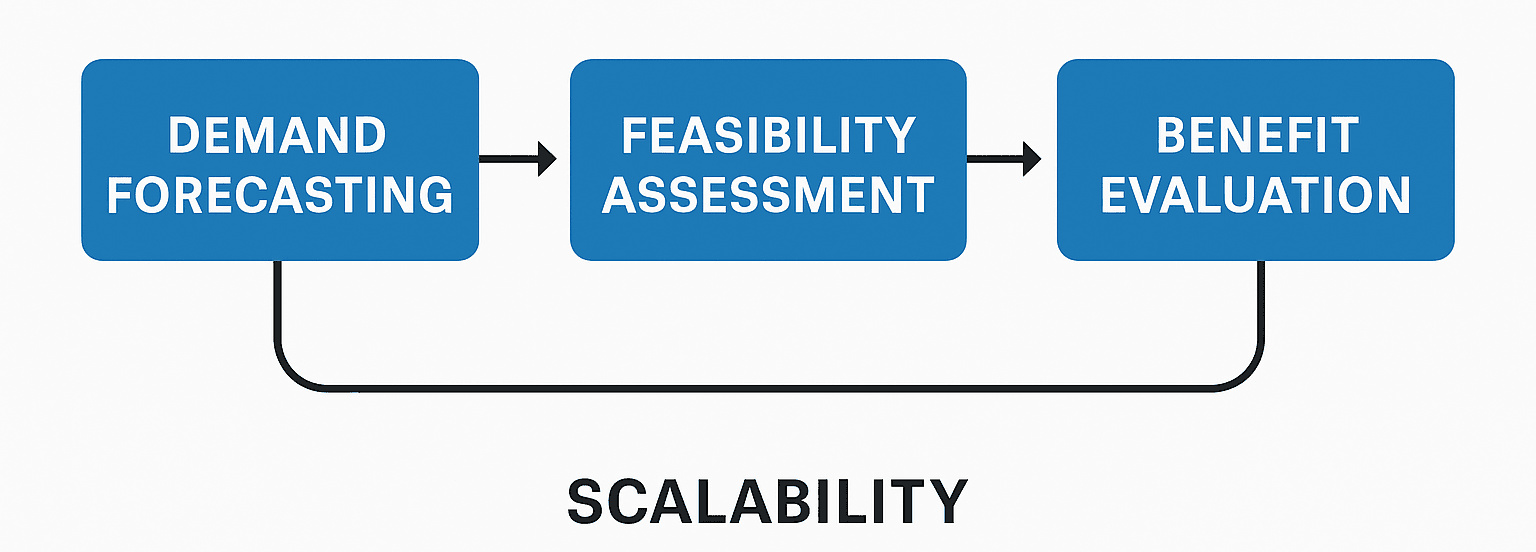
The research team at Penn State developed a three-pronged framework focused on demand forecasting, feasibility assessment and quantifying benefits. They used AI models trained with land-use, traffic volume and points-of-interest data to identify optimal locations and ensure equitable deployment.
They partnered with municipal utilities and the National Renewable Energy Laboratory (NREL) and other stakeholders to retrofit the infrastructure and collected data for one year to compare performance.
Findings & Innovations
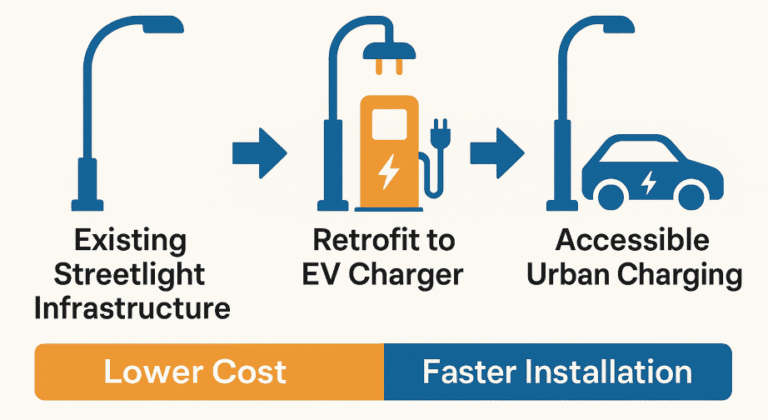
- Cost & Speed Advantage: The study found that retrofitting streetlamps was significantly cheaper and faster compared to conventional charging stations, since the power lines already existed.
- Equitable Access: A major innovation is the AI-driven location strategy that considers socio-economic factors to maximise inclusive access for under-served urban communities.
- Environmental Impact: The streetlight-charging approach yielded tangible gains in greenhouse-gas reductions and fuel savings by optimising locations where cars already park.
Industry Impact & R&D Implications
From an industrial standpoint, this innovation offers new business models for utilities, charging-station manufacturers and urban planners. The ability to deploy charging infrastructure at lower cost and within existing assets opens up markets for sensor and connectivity firms, IoT platforms, and data-services companies that support smart-city energy systems.
On the research side, there are clear pathways for scaling: sensor integration (to monitor charger usage, grid load), AI systems (for demand forecasting and equitable siting), and materials/system engineering (for retrofits with minimal disruption).
At BMF-Science, this reflects our mission: facilitating connections between academic research (e.g., at Penn State) and industry partners who can commercialize and scale innovations. Projects like this represent perfect opportunities for technology transfer, enabling urban infrastructure innovation to reach market-scale deployment.
Funding, Collaboration & Strategic Opportunities
The project was supported by the U.S. Department of Energy, in collaboration with municipal utility agencies and the NREL. This underscores a key trend: government-backed funding programs that support scalable, equitable, and sustainable infrastructure solutions – an excellent entry point for R&D collaborations.
For industry partners, the framework implies opportunities to partner with academic labs and municipal utilities to pilot new sensor systems, smart grid integration, charging-station hardware or software analytics. Such collaborations align with broader themes of urban electrification, smart mobility and sustainable cities.
BMF-Science Perspective
At BMF-Science, we recognize the high value of translating urban-scale innovations into marketable solutions. The streetlight-charging concept is a textbook example of how academic research can meet industrial and societal needs: lower cost, equitable access, and scalable deployment. If your institution develops next-gen IoT sensors, AI-driven energy-demand models or retrofit hardware for smart infrastructure, we can help you identify industry partners, secure funding and navigate the pathway from prototype to pilot to full deployment.
Partner with BMF-Science to access our global network of industry collaborators, funding expertise and strategic pathways to bring your innovations to market.