Table of Contents
Introduction
Antibiotic pollution in water has emerged as one of the most pressing global environmental challenges, leading to the proliferation of drug-resistant bacteria and ecological imbalance. Scientists have long sought an efficient, low-energy, and sustainable technology to degrade these contaminants. A recent breakthrough — reported in Bioengineer.org (October 2025) — introduces a novel S-scheme photocatalyst that efficiently purifies antibiotic-contaminated water under visible light irradiation.
This innovation represents a milestone in environmental nanotechnology, integrating advanced semiconductor design with sustainability principles. For institutions and industries engaged through BMF-Science, the discovery underscores how academic R&D can directly support environmental protection and industrial water treatment.
Background & Context
Traditional wastewater-treatment methods often struggle to remove pharmaceutical pollutants, particularly antibiotics, which persist through biological and chemical treatment. Photocatalysis — using light-activated semiconductors to degrade pollutants — offers a promising alternative, but conventional photocatalysts face limits in efficiency, selectivity, and light-absorption range.
To overcome these constraints, the research team developed a revolutionary S-scheme photocatalyst, designed to promote efficient charge transfer and maintain strong redox capability under visible-light exposure — a key advantage for sustainable, real-world applications.
Technological & Scientific Insights
How the S-Scheme Photocatalyst Works
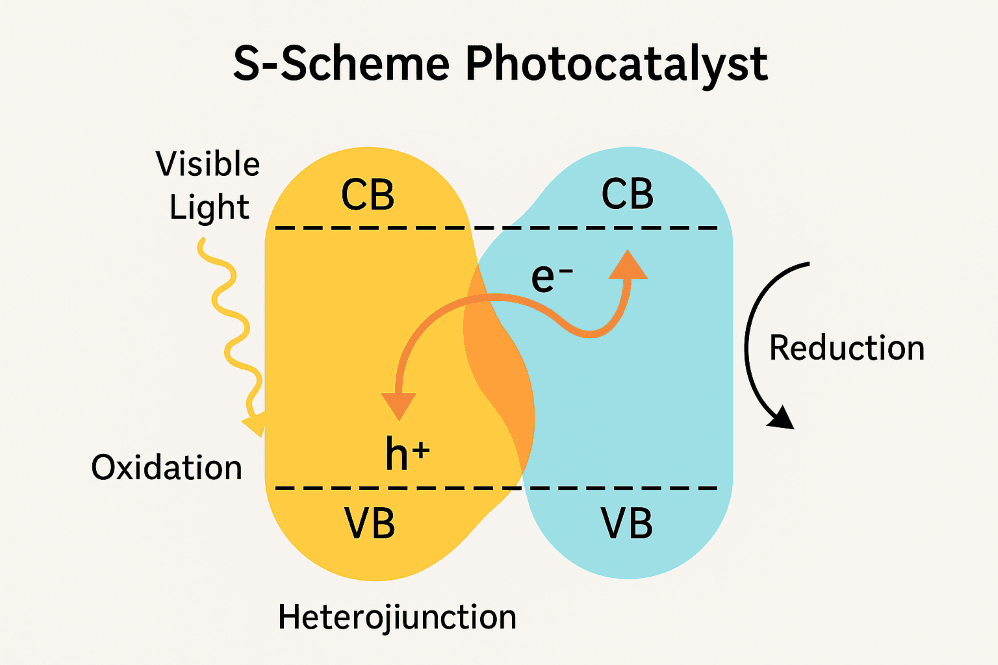
The S-scheme design refers to a sophisticated heterojunction structure between two semiconductors that enables efficient spatial separation of electrons and holes – the charged carriers responsible for pollutant degradation.
Unlike conventional “Z-scheme” systems, the S-scheme improves energy alignment between conduction and valence bands, enhancing redox reactions and preventing recombination losses. This design maximises the number of reactive species that can attack antibiotic molecules in water, accelerating decomposition.
Visible-Light Activation
The new material operates under visible-light irradiation, eliminating the need for high-energy ultraviolet sources typically required in photocatalytic treatment. This makes it energy-efficient and suitable for large-scale wastewater treatment in industrial or municipal systems.
Key Performance Metrics
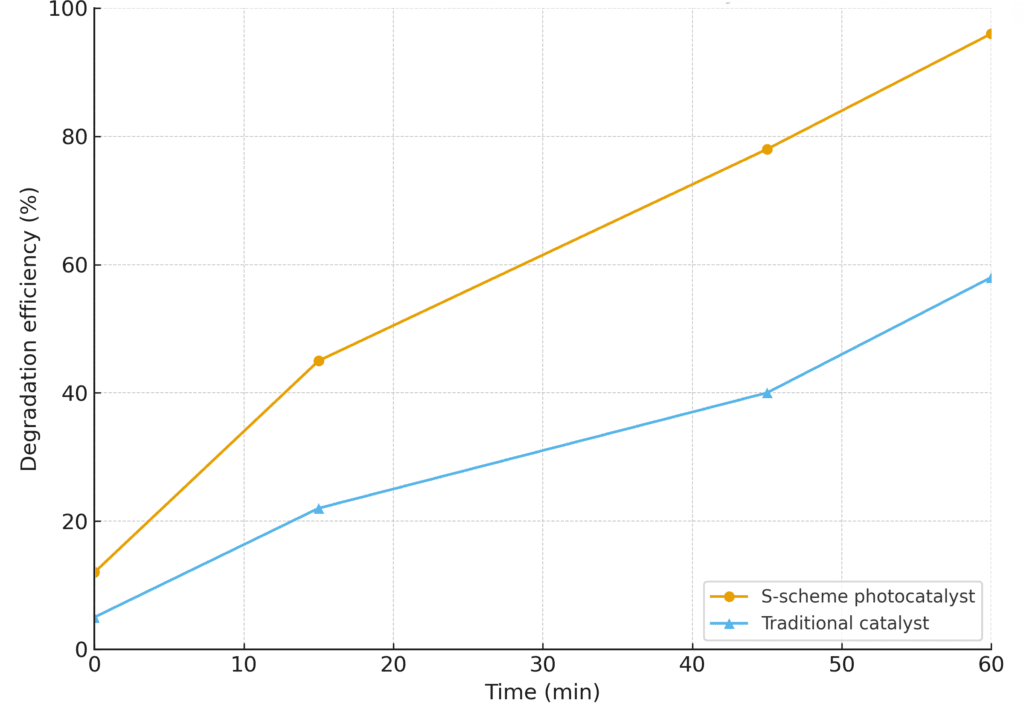
- Achieved nearly complete degradation of antibiotic residues in contaminated water samples.
- Demonstrated long-term photostability over multiple cycles of reuse.
- Exhibited superior charge-separation efficiency and light-harvesting capacity compared to traditional catalysts.
These properties suggest the material could be deployed both in industrial effluent purification and decentralised clean-water technologies.
Industry Impact & Research-to-Industry Implications
This breakthrough offers transformative potential for environmental technology sectors:
- Industrial wastewater management: Pharmaceutical, textile, and food-processing plants can adopt S-scheme photocatalysis to remove residual antibiotics, dyes, or organic pollutants.
- Water-treatment startups: The technology provides a foundation for developing modular, solar-driven purification systems — a growing market within green infrastructure.
- Policy & ESG compliance: As governments tighten effluent standards, this innovation offers a scientifically proven path to achieving sustainability targets.
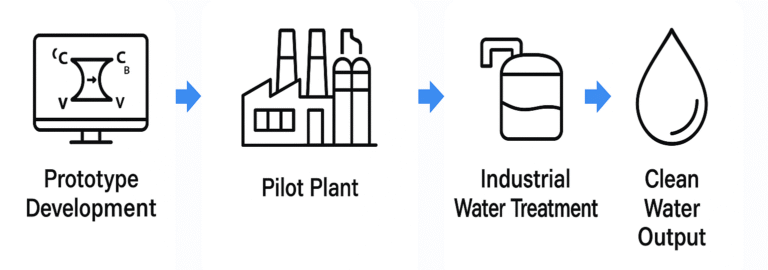
For academia and industry alike, the S-scheme photocatalyst opens new avenues for joint research and licensing, allowing materials scientists, chemical engineers, and environmental firms to collaborate on scaling prototypes and pilot systems.
At BMF-Science, we see this as an archetype of technology transfer — converting high-impact lab research into industrial solutions for global environmental challenges.
Scientific Collaboration and R&D Opportunities
The research exemplifies how multidisciplinary collaboration accelerates technological maturity:
- Materials science teams design and characterise nanostructured catalysts.
- Environmental engineers evaluate degradation efficiency under real wastewater conditions.
- Industry partners test scalability, reactor integration, and economic feasibility.
Potential funding avenues include EU Green Deal, Horizon Europe’s environmental innovation programmes, and industrial partnerships focused on sustainable chemistry. For companies aiming to reduce environmental impact or align with circular-economy goals, engagement in such R&D collaborations is both strategic and socially responsible.
BMF-Science Perspective
BMF-Science champions the convergence of academic discovery and industrial application.
This photocatalyst innovation represents the type of technology we strive to promote: scientifically rigorous, environmentally beneficial, and commercially viable.
By connecting research labs developing advanced catalysts with water-treatment firms and investors, BMF-Science helps bridge the “valley of death” between proof-of-concept and full-scale deployment.
We facilitate:
- Identification of industrial partners interested in testing and co-developing prototypes.
- Access to funding for green innovation.
- Dissemination of results through our scientific committee and industry network.
Together, we can advance the science-to-industry pipeline for sustainable water purification.