Table of Contents
Introduction
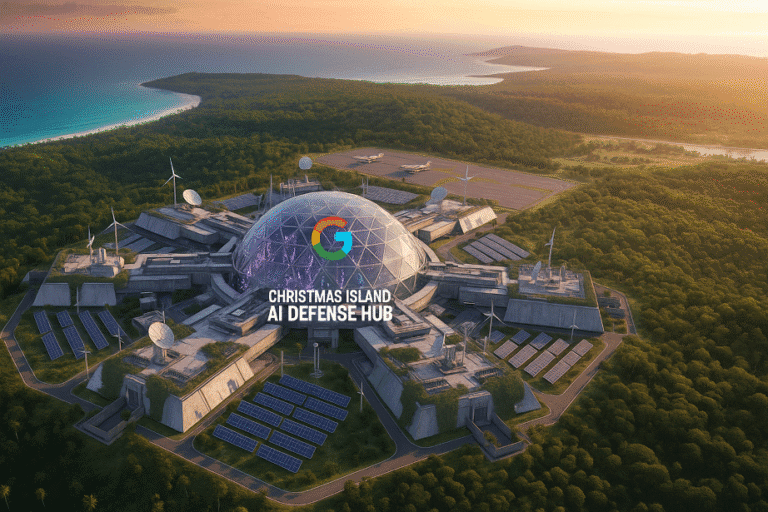
In a move that reshapes the geography of global computing, Google is establishing a powerful AI data centre on Christmas Island, an Australian territory in the Indian Ocean.
According to Reuters (November 2025), the facility will form a critical part of Google’s expanding cloud and AI infrastructure network across the Asia-Pacific. This development is more than a corporate expansion — it represents a convergence of technological innovation, geopolitical strategy, and sustainable engineering.
For an organisation like BMF-Science, which thrives at the intersection of research and industry, this project is a prime example of how large-scale infrastructure projects can create opportunities for R&D collaboration, data innovation, and sustainable technology transfer.
Background & Context: Why Christmas Island?
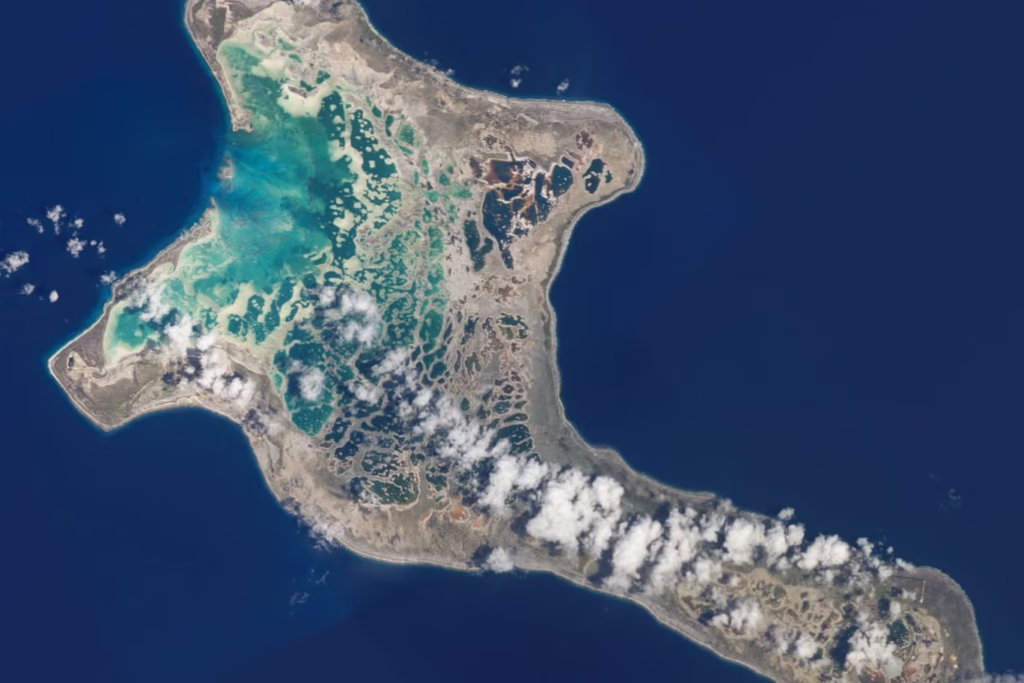
Christmas Island, a small Australian outpost closer to Indonesia than mainland Australia, is emerging as an unexpected yet strategically brilliant choice.
The location offers:
- Proximity to major data routes between Asia and Australia.
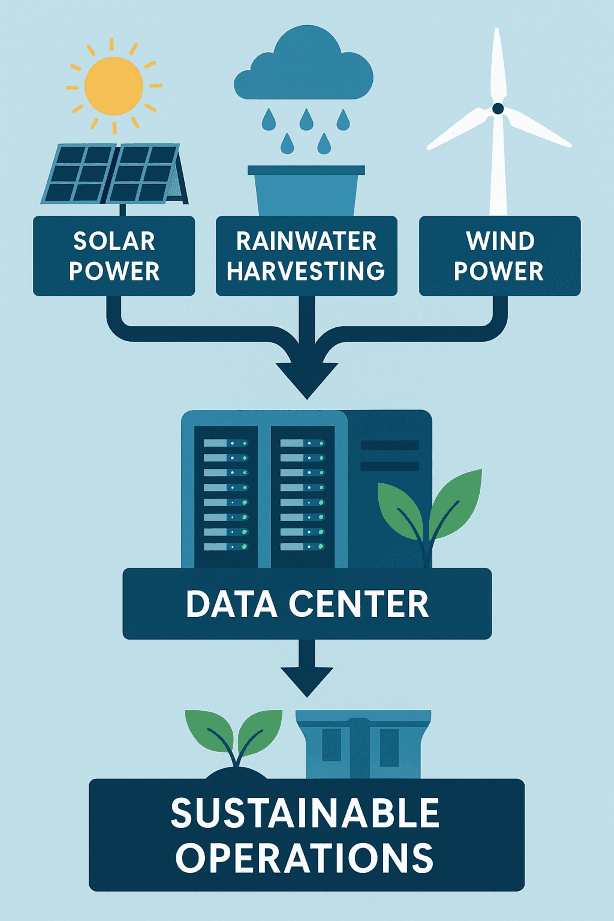
- Access to renewable and modular energy sources, key to powering AI-intensive systems.
- Geopolitical significance, strengthening Australia’s digital sovereignty while balancing influence across the Indo-Pacific.
By selecting such a remote site, Google addresses both infrastructure distribution (decentralizing data processing from urban hubs) and resilience, ensuring redundancy in its global cloud network.
Technological & Scientific Insights
AI Infrastructure Meets Environmental Intelligence
The planned data centre will support Google’s rapidly scaling AI model training and deployment for the Asia-Pacific region. These operations require vast computational capacity — typically accompanied by enormous power consumption.
Google’s approach integrates advanced cooling systems, renewable energy sources, and AI-driven energy optimisation, a model previously piloted in its Finland and Singapore facilities.
From a research perspective, the Christmas Island project could act as a living laboratory for sustainable computing:
- Testing AI algorithms for dynamic cooling and energy efficiency.
- Integrating marine energy systems and battery storage suited to remote islands.
- Monitoring biodiversity and environmental impact through embedded IoT sensors and AI analytics.
These interdisciplinary touchpoints — spanning data science, engineering, and environmental monitoring — align perfectly with BMF-Science’s mission of facilitating science-industry synergy.
Industry Impact & Research-to-Industry Implications
This AI data center represents more than infrastructure — it’s a catalyst for regional innovation ecosystems.
- R&D Collaboration Opportunities: Universities and research institutions can engage in joint studies on AI optimization, smart grids, and edge computing.
- Technology Transfer: Local companies could benefit from proximity to cutting-edge cloud infrastructure, fostering skills development and innovation spillover.
- Sustainability Benchmarking: The project could set new standards for low-carbon digital infrastructure, influencing data-center design worldwide.
At BMF-Science, we see this as an ideal example of public-private synergy, where technological investment drives sustainable and scientific advancement across disciplines — from materials engineering to renewable energy management.
Socio-Geopolitical Significance
While the initiative is primarily technological, it carries profound geopolitical and social dimensions.
The AI data center strengthens Australia’s role as a trusted regional data hub, ensuring that information storage and AI services remain within allied infrastructure — a growing priority amid global debates on data sovereignty.
For Christmas Island, the project brings potential economic revitalization through high-tech jobs, infrastructure upgrades, and renewable energy investment.
Yet, as with all large-scale technological expansions, community engagement and environmental stewardship will be crucial—ensuring that innovation uplifts local ecosystems and economies simultaneously.
Funding, Collaboration & Strategic Opportunities
This initiative demonstrates how large-scale corporate infrastructure can intersect with academic research and public-policy goals.
For example:
- Joint research on energy-efficient data systems under sustainability funding programs.
- Policy innovation projects involving regional governments and environmental agencies.
- Skill development partnerships to train local engineers and technicians in AI, data security, and renewable systems integration.
These models align perfectly with BMF-Science’s collaborative vision — linking industry and academia to enable responsible technological growth.
BMF-Science Perspective
The Christmas Island data-centre project embodies a future where AI, sustainability, and geopolitics converge.
It demonstrates how scientific ingenuity can serve both economic and environmental objectives, setting a precedent for responsible innovation.
BMF-Science will continue to monitor such initiatives, identifying entry points for cross-disciplinary partnerships — from energy research to AI ethics, from hardware innovation to environmental monitoring.